

 " alt="Supporting World Bicycle Relief in providing bicycles for education in Uganda">
©All rights reserved World Bicycle Relief
" alt="Supporting World Bicycle Relief in providing bicycles for education in Uganda">
©All rights reserved World Bicycle Relief
Supporting World Bicycle Relief in providing bicycles for education in Uganda
Grantee: World Bicycle Relief Switzerland
Location: Uganda, Africa
Grant Cycle: 2026
Type of Grant: one-year program support, Human Welfare & Rights
Website: worldbicyclerelief.org
Human Welfare
& Rights
World Bicycle Relief was founded in 2005 by F.K. Day, co-founder of SRAM Corporation, and his wife, documentary photographer Leah Missbach Day, in response to the Indian Ocean tsunami. In its initial humanitarian response, the organization distributed more than 24,000 bicycles to displaced survivors, restoring access to education, healthcare, and livelihoods while helping reconnect entire communities.
Today, World Bicycle Relief accelerates pathways out of poverty for more than 5 million people across 21 countries by improving access to essential services and economic opportunities through sustainable mobility solutions. Working in partnership with rural communities, scaling partners as well as local and national government, particularly women and girls, the organization develops and maintains transportation ecosystems that address barriers to education, healthcare, and livelihoods, with a strong emphasis on gender inclusion. To date, this approach has been implemented through the distribution of 1million Buffalo Bicycles, alongside sustainable bicycle ecosystems. Designed for durability, ease of repair, and low cost of ownership, these bicycles provide a reliable, long-term solution for mobility in underserved regions.
World Bicycle Relief began its operations in Uganda in 2016, focusing on rural communities where nearly half of the population lives in poverty. In these areas, distance represents a significant barrier to education: approximately one in three rural students lives 3 km or more from the nearest primary school. This contributes to high dropout rates, estimated at 45% among rural primary students, as well as low enrollment levels and overall educational attainment. Limited access to affordable and reliable transportation further exacerbates these challenges. Motorized transport remains largely cost-prohibitive for rural populations, and bicycle ownership is relatively low, with only 33% of households owning a bicycle. Access is particularly constrained among women and youth, and the cost of a bicycle remains a primary barrier to ownership.
In response, in 2026 World Bicycle Relief aims to mobilize students in the West Nile region of Northern Uganda, who live 3 km or more from school. By providing Buffalo Bicycles, the initiative seeks to reduce distance-related barriers to education, improve attendance and retention rates, and enhance students’ overall well-being by significantly decreasing daily travel time and physical strain. Improved mobility also enables students to arrive at school on time, better prepared to learn, and more likely to complete their education.
The bicycles will be owned by participating schools and allocated to students for the duration of their studies, ensuring equitable access and institutional oversight. Students will be responsible for the proper use and basic maintenance of the bicycles, fostering a sense of ownership and accountability. Upon graduation, each bicycle will be returned to the school and reassigned to another student, creating a sustainable, revolving system that extends impact over multiple cohorts.
Supported by the Nando and Elsa Peretti Foundation (NaEPF), the project will reach 915 students in 2026, including approximately 640 girls, with a strong emphasis on gender equity in access to education. In parallel, the initiative will support the training of local mechanics, strengthening community-level technical capacity and ensuring the long-term maintenance and functionality of the bicycles. This integrated approach combines immediate educational benefits with sustainable infrastructure and skills development, contributing to lasting improvements in access to education in underserved rural communities.
Before receiving the bicycle, I would spend up to one hour and thirty minutes walking to school. Now, my journey takes less than 25 minutes. This has significantly impacted on my ability to attend school on time and regularly. With the bicycle, I no longer face the risk of sexual favour requests from motorists, which was a constant challenge when I asked for lifts to and from school. The bicycle not only serves me during school days but it is also helpful on weekends. After school, I use it to fetch water and assist with household chores. It has become an essential tool in our household’s daily life.
Caroline 8-year-old Senior Four student at St. Thereza Secondary School in Bukedea District who experienced a turning point in her educational journey through access to a Buffalo Bicycle
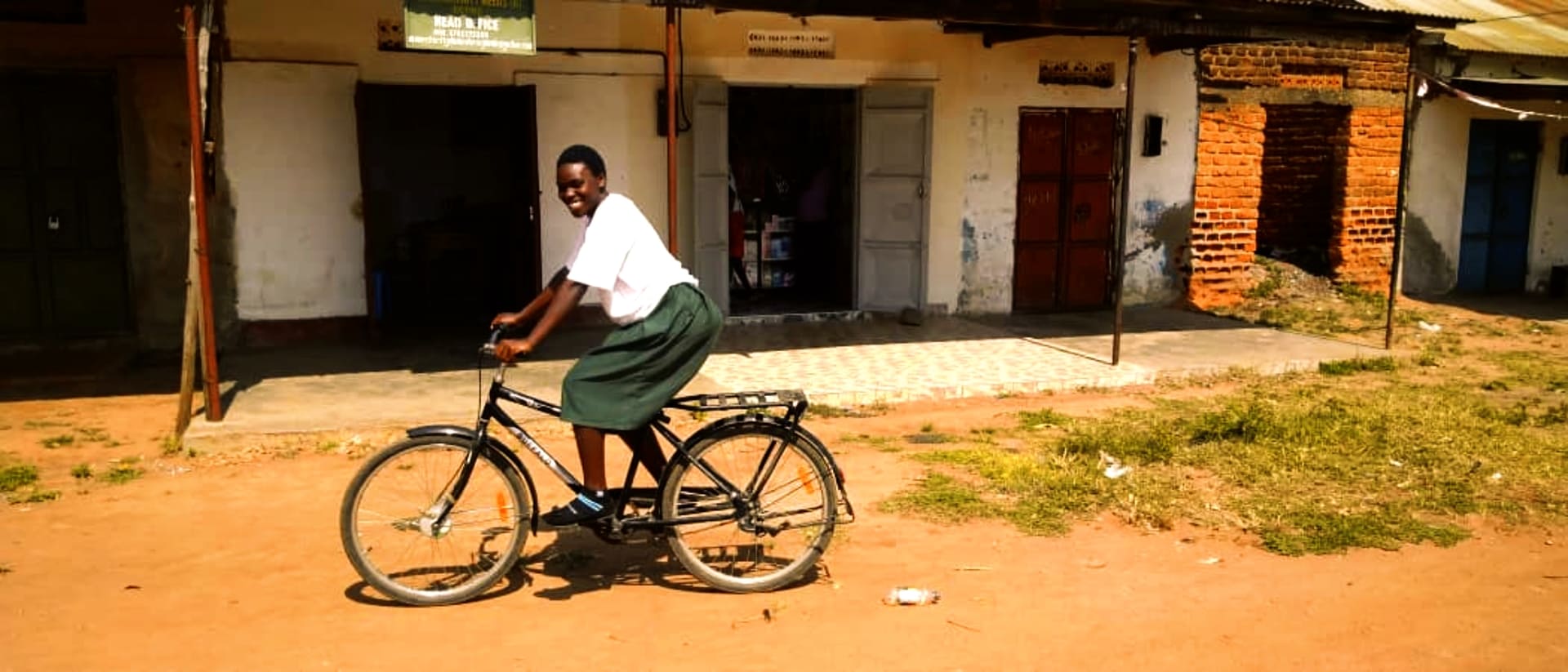 Caroline with her Buffalo Bicycle
 ©All rights reserved World Bicycle Relief
