

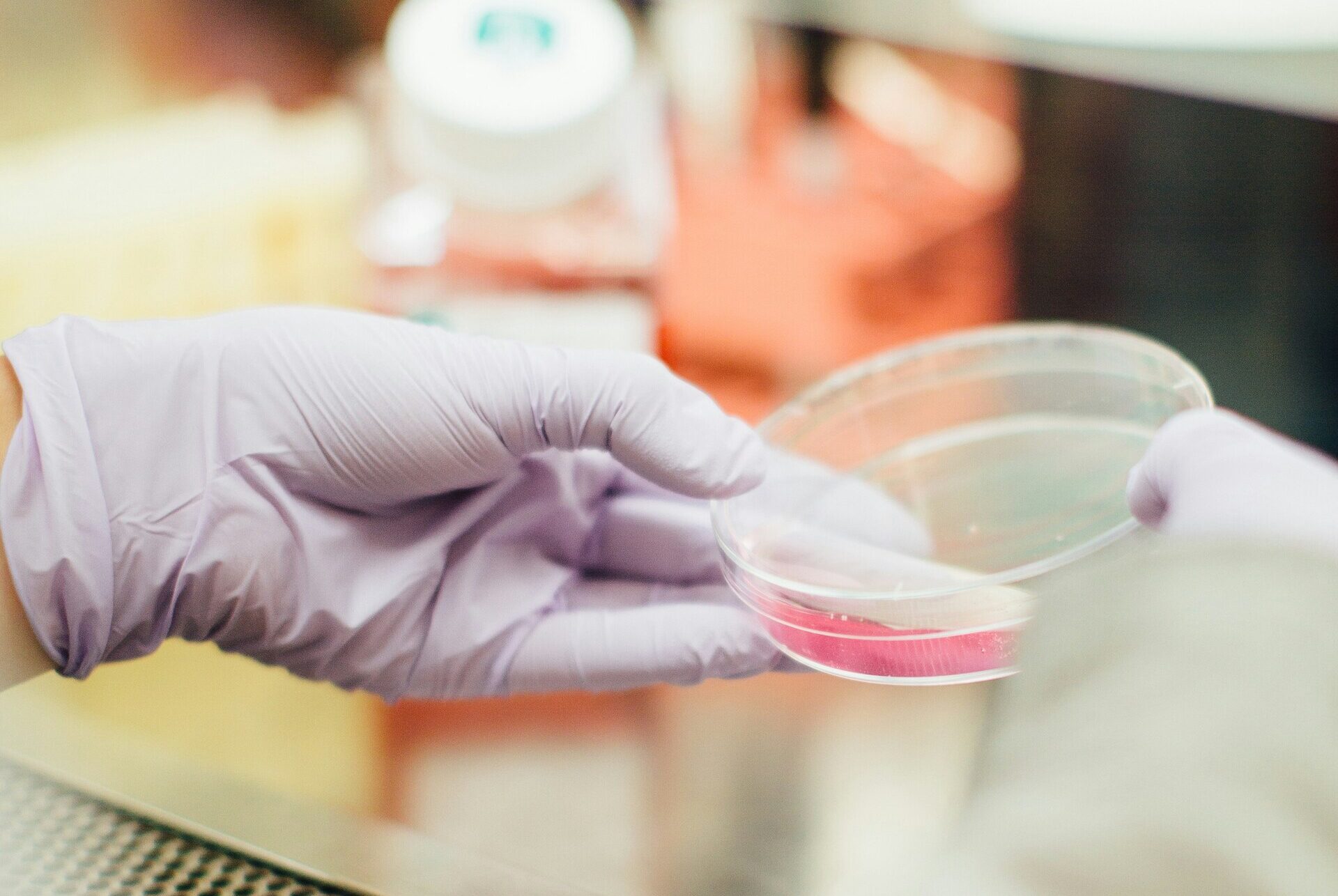
 " alt="The Peretti–Schmucker Fellowship in skin biomaterials research at the Max Planck Institute for Polymer Research">
The Peretti–Schmucker Fellowship in skin biomaterials research at the Max Planck Institute for Polymer Research
Grantee: Max Planck Institute for Polymer Research (Max-Planck-Gesellschaft)
Location: Germany, Europe
Grant Cycle: 2026-2028
Type of Grant: three-year program support, Human Welfare & Rights
Website: mpip-mainz.mpg.de
Human Welfare
& Rights
The Max Planck Society (MPG) is an internationally recognized, autonomous research organization with the guiding principle “Insight must precede application” by its namesake, Max Planck. The basic research conducted at the very highest level is founded on brilliant minds, a high degree of freedom, and excellent working conditions. Its primary objective is to conduct excellent fundamental research in the service of the public interest, with a strong emphasis on innovative and interdisciplinary approaches. In 1948, the MPG succeeded the Kaiser Wilhelm Society, founded in 1911. Today, the Max Planck Society comprises a network of 85 Max Planck Institutes and research facilities, as well as four institutes located outside Germany. The organization has been associated with 31 Nobel Laureates among its scientists, reflecting its long-standing contribution to scientific excellence across a wide range of disciplines. In addition to its research activities, the Max Planck Society promotes the development of young scientific talent through for example international doctoral programmes that attract highly qualified Ph.D. candidates from around the world to pursue advanced research training in Germany.
The Nando and Elsa Peretti Foundation (NaEPF) has long been committed to supporting health promotion and medical scientific research with the aim of enhancing community well-being. In line with this commitment, in 2023 the NaEPF established the Peretti-Schmucker Fellowship at the Max Planck Society to support research in skin biology in memory of Dr. Yvonne Katharina Schmucker, dermatologist and friend of the Foundation.
Dr. Jasmina Gačanin, group leader of the Cell-instructive Materials group at the Max Planck Institute for Polymer Research in the department of Prof. Dr. Tanja Weil, has been appointed Peretti-Schmucker Fellow. Dr. Gačanin is internationally recognized for her pioneering work on engineering predictable supramolecular interactions into biological building blocks that form programmable soft materials, in which peptide amino- acid sequence encodes supramolecular architecture, physicochemical function, and macroscopic behavior. By programming this information directly into the molecular sequence, together with her group she creates functional materials that mimic the structural sophistication of biological systems while enabling synthetic tunability and robustness. Such intelligent materials hold significant potential for applications in fields such as the treatment of severe skin diseases.
I am very honoured to have been awarded a Peretti-Schmucker fellowship research grant. Thanks to the support of the Nando and Elsa Peretti Foundation, the biomedical material development related research in my group is strengthened and we will be able to contribute to new functional biomaterials and medical solutions in dermatology. Working on this project will encourage interdisciplinary collaboration and cutting-edge research at leading research institutions to shape the future of (skin) biomaterials.
Dr. Jasmina Gačanin group leader of the Cell-instructive Materials group at the Max Planck Institute for Polymer Research in Mainz
The skin, the largest organ in the human body, plays a vital role in health as the first line of defence and a protective barrier between the environment and internal tissues. However, its composition and function can be significantly altered by exposure to allergens, toxins, and irritants, including preservatives commonly found in consumer products, as well as by medical conditions such as acne, chronic diabetic ulcers, and skin cancer. These conditions often require targeted or personalized treatments to restore the skin’s integrity, homeostasis, and functionality, which cannot always be effectively achieved with conventional therapeutic approaches. Recent advances in biomaterials research highlight the significant potential of living biomaterials for the treatment and regeneration of skin tissue.
The Peretti-Schmucker Fellowship supports research investigating hydrogel, cell formulations as living biomaterials that could be applied in next-generation therapeutic approaches for skin-related conditions, including wound healing and tissue engineering. Through this research, the initiative seeks to advance innovative strategies in regenerative medicine and dermatological care. Within this project, specialized hydrogels, soft, tissue-like three-dimensional materials, are being developed as scaffolds capable of hosting living cells. By combining biopolymers that form hydrogels with living cells, these materials aim to create functional living biomaterials that harness biological processes to support skin homeostasis, promote tissue regeneration, and enhance wound healing.
Building on the success of the research conducted by Dr. Gačanin, the Nando and Elsa Peretti Foundation has extended the Peretti-Schmucker Fellowship until 2028 to further address pressing and interconnected challenges related to innovative material properties and therapeutic approaches for dermatological care. This new phase of the project focuses on advancing the development of topical formulations through the use of environmentally sustainable, bio-based polymers for next-generation hydrogel materials.
The research explores newly developed biomaterials, including hydrogels and hydrogel-cell formulations, which hold significant potential for improving treatment strategies for skin-related conditions, wound healing, and tissue engineering. These soft, tissue-like three-dimensional materials possess network structures that can function as effective scaffolds for dermatological and regenerative applications.
Within this framework, novel bio-based hydrogels will be designed to surpass current state-of-the-art materials in terms of sustainability, degradability, handling properties, and mechanical performance. By integrating natural biopolymers capable of forming functional hydrogel networks, the project aims to develop advanced biomaterials that support skin homeostasis, promote tissue regeneration, and enhance wound-healing processes.
In addition, the hydrogels will be developed as living biomaterials capable of hosting viable cells. While recent advances in medical materials research have highlighted the potential of living biomaterials for dermatological applications, several limitations remain, including insufficient biodegradability and biocompatibility, challenges related to reproducibility and material stability, and practical issues affecting handling and performance such as poor skin adhesion and detachment during body movement.
By addressing these limitations, the project aims to develop more robust and effective biomaterial solutions. In particular, key mechanical properties, such as self-healing capacity, will be incorporated into the hydrogel systems, enabling the materials to dynamically adapt to skin movement and mechanical stress. This approach is expected to improve the functionality and clinical applicability of biomaterials designed for skin repair and regeneration.
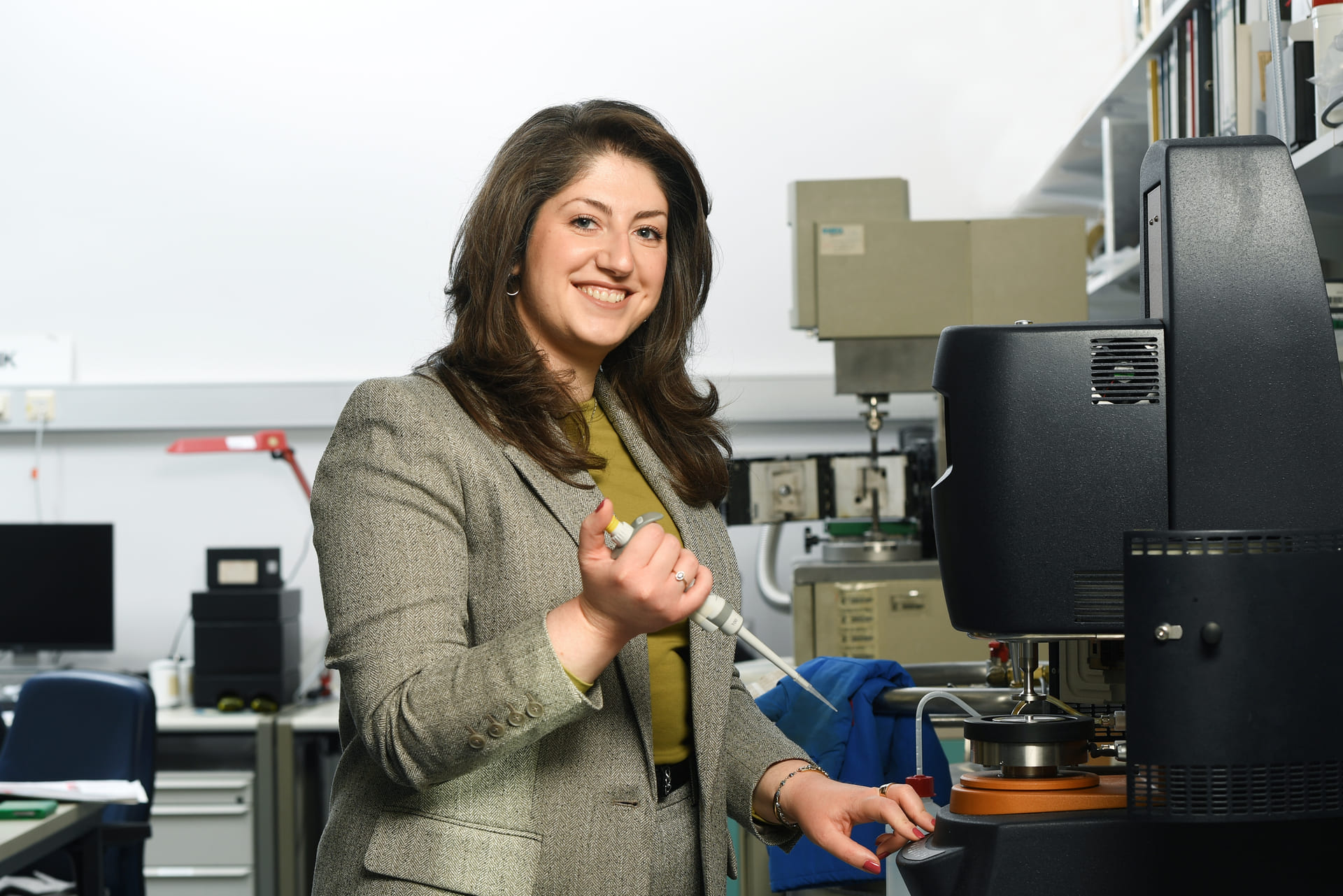 Dr. Jasmina Gačanin
 ©All rights reserved Max Planck Institute for Polymer Research (Max-Planck-Gesellschaft)
